Wire mesh is a primary solution for screening, separation, filtration and security. To ensure your operation performs efficiently, you must select the correct wire mesh. Two of the most widely used types are crimped wire mesh and woven wire mesh.
While they share similar materials and visual features, their manufacturing processes, structural behaviors, and ideal applications differ significantly.
What Is Crimped Wire Mesh?
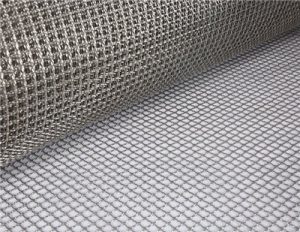
Crimped wire mesh is a woven wire variant where individual wires are pre-bent-or “crimped”-into a consistent, uniform zig-zag pattern prior to the weaving process.
How It’s Made
During manufacturing, high-precision wheels or dies deform the wire at regular intervals before the wires are interlaced on a loom. This pre-crimping locks the warp and shute wires tightly into place at every intersection.
Crimped wire mesh is available in a variety of alloys, including:
Stainless Steel (e.g., 304, 316)
Carbon Steel
Aluminum
Copper & Brass
Depending on the intended load and aperture size, it can be produced in several weave profiles, including plain crimp, intermediate crimp, and flat-top crimp.
Key Advantage: Pre-crimping creates exceptional structural rigidity and locks the aperture sizes in place, preventing the wires from shifting even under heavy loads or severe mechanical vibration.
What Is Woven Wire Mesh?
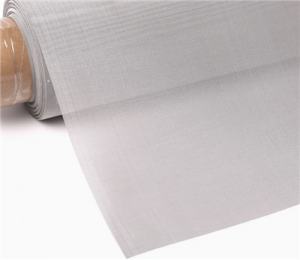
Woven wire mesh is a metallic fabric manufactured using a traditional, highly precise weaving process similar to textile production.
How It’s Made
Straight wires are interwoven in an over-under orientation at right angles without any pre-crimping steps. The tension of the weave maintains the rigidity and alignment of the mesh openings.
What makes woven wire mesh so popular across modern engineering is its extreme customizability. Virtually every parameter can be tailored to meet strict performance metrics:
Wire Diameter: From ultra-fine microscopic threads to heavy-gauge wires.
Mesh Count: The number of openings per linear inch, ranging from coarse screens to micron-grade meshes.
Weave Types: Plain weave, twill weave, Dutch weave, and reverse Dutch weave.
Alloys: Stainless steel, nickel, copper, titanium, aluminum,steel and more.
Key Advantage: Standard woven wire mesh offers superior precision, smooth surface finishes, and high flexibility, making it easy to form into custom shapes, cylinders, or filter elements.
Key Differences: Crimped Wire Mesh and Woven Wire Mesh
Understanding the core structural and operational differences between these two mesh types is crucial for selecting the right material.
| Feature | Crimped Wire Mesh | Woven Wire Mesh |
| Pre-Processing | Wires are pre-crimped (zig-zag pattern) before weaving | Wires are woven straight into the loom without pre-crimping |
| Surface Texture | Textured, ridged surface | Comparatively smooth, flush surface |
| Structural Rigidity | Very High; rigid grid locks openings in place | Moderate to High; depends on wire gauge and density |
| Flexibility & Formability | Rigid; harder to bend or roll into tight radiuses | High; easier to cut, shape, plead, or roll |
| Mechanical Stress Tolerance | Exceptional resistance to heavy impacts and high loads | Best suited for low-to-moderate mechanical tension |
| Filtration Fineness | Ideal for medium-to-coarse screening | Ideal for fine, ultra-fine, and micron-level filtration |
- Structural Rigidity and Mechanical Strength
Because crimped wire mesh features interlocking indentations, the wires are physically prevented from sliding out of alignment. This makes crimped mesh exceptionally stable under heavy mechanical stress, impact, or high-vibration environments. Standard woven mesh relies on weave tension; while stable, ultra-fine woven meshes can deform more easily if subject to extreme physical force.
- Surface Finish and Precision
Standard woven wire mesh provides a smooth, flat surface because straight wires pass over and under one another without raised crimps. This smooth texture prevents material clogging during fine particle separation. Crimped wire mesh exhibits a textured, three-dimensional surface due to the wire bends, which aids in breaking up aggregated materials in heavy-duty screening.
Crimped Wire Mesh and Woven Wire Mesh: Which Should You Use?
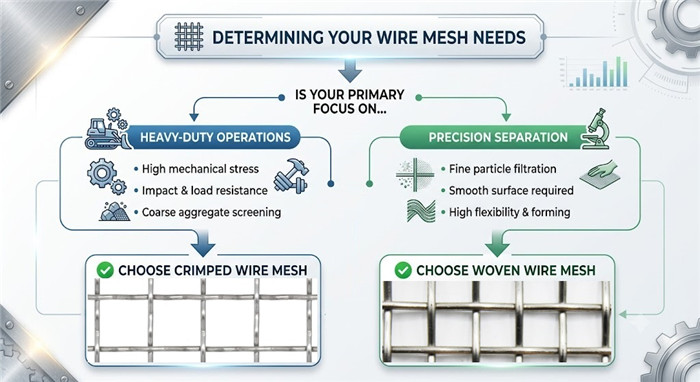
The optimal choice comes down to the primary requirement of your operation: heavy-duty structural durability or precision filtration and flexibility.
Choose Crimped Wire Mesh
If you work in heavy-duty industries: Mining, quarrying, aggregate processing, and heavy construction.
If your application experiences severe impact: Scalping screens, vibrating screen decks, and heavy crushers.
If you need structural security: Architectural infill panels, security grilles, protective machinery guards, and livestock fencing.
If opening accuracy under load is vital: You need large or medium apertures that will not shift or deform under weight.
Choose Woven Wire Mesh
If precision is critical: Fine liquid filtration, gas purification, micron sieving, and pharmaceutical processing.
If you require custom fabrications: Pleated filter cartridges, strainers, small wire baskets, or complex deep-drawn shapes.
If you need a smooth surface: Applications where friction must be minimized or where delicate materials pass over the mesh.
If you need fine mesh counts: High-density meshes required for chemical, aerospace, or food and beverage manufacturing.
Both crimped wire mesh and woven wire mesh are indispensable solutions across modern industry. Choosing between them isn’t about which mesh is inherently better, but rather which mesh is engineered for your specific operational demands.
Crimped Wire Mesh is the heavy-duty powerhouse built for strength, rigid aperture stability, and high mechanical impact.
Woven Wire Mesh is the versatile, high-precision performer built for fine filtration, flexibility, and custom fabrication.
By carefully evaluating your target particle sizes, mechanical load, environment, and forming requirements, you can select the perfect wire mesh solution to maximize operational efficiency and longevity.
