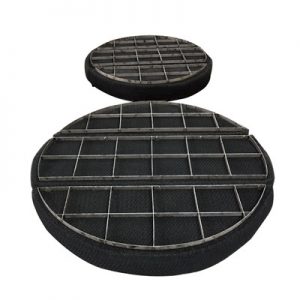
A titanium wire mesh demister is a highly efficient and reliable gas-liquid separation device designed specifically for harsh corrosive environments.
What is a titanium mesh demister pads?
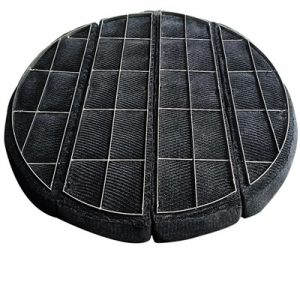
It is a pad-like separation element constructed by weaving titanium wire (such as commercially pure titanium Grade 1 or 2, or titanium alloys) into a mesh, which is then layered and compressed according to specific requirements.
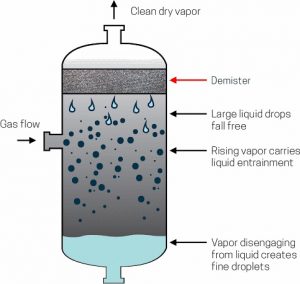
Demister pads working principle
When gas containing liquid droplets or mist passes through the mesh at a certain velocity, the fine droplets collide with the titanium wire surfaces, where they are captured and coalesce. Once the small droplets merge into larger ones, their weight overcomes the combined forces of the rising gas and liquid surface tension, causing them to fall and thereby achieving gas-liquid separation.
Key advantages
1.Superior corrosion resistance is the primary reason for choosing titanium.
Titanium exhibits excellent resistance to the following highly corrosive media:
Chloride ions: Titanium resists corrosion from seawater, wet chlorine gas, and chloride solutions-environments where stainless steel would suffer from catastrophic pitting and stress corrosion cracking.
Oxidizing media: It offers good corrosion resistance against oxidizing acids, such as chromic acid.
Other media: It also demonstrates excellent resistance to alkaline solutions and organic compounds.
2.High strength and low density: Titanium combines high strength with a low density (approx. 4.51 g/cm³) that is far lower than that of stainless steel (approx. 7.9 g/cm³), resulting in lighter weight and a superior strength-to-weight ratio.
3.Good compatibility: In industries such as pharmaceuticals, food processing, and fine chemicals, titanium meets cleanliness and hygiene standards without introducing contamination.
Demister Pads Key application
Titanium wire mesh demisters are specifically designed to handle highly corrosive gases and are widely used in the following industries:
Petrochemicals
Chlor-alkali industry: Used for demisting and drying wet chlorine gas from electrolytic cells; this is the most classic and critical application for titanium wire mesh demisters, as they effectively remove alkali mist and moisture from the gas.
PTA (Purified Terephthalic Acid) production: Used during the oxidation process to handle gases containing highly corrosive media.
Fine Chemicals: Tail gas treatment and product recovery for processes involving reactions such as chlorination and sulfonation.
Environmental Engineering
Hydrometallurgy: Treatment of exhaust gases containing chloride ions and mists.
Exhaust Gas Treatment (Acid Mist Purification): High-efficiency removal of strong acid droplets; for example, at the tops of purification towers in titanium dioxide production and pickling operations.
Power and Marine Engineering
Flue Gas Desulfurization (FGD) Systems: Handling saturated wet flue gas containing unreacted acid mist and chloride ions to protect downstream flues and equipment.
Offshore Platforms: Handling gases in marine environments with high chloride ion concentrations.
Pharmaceutical and Food Industries
Used in processes requiring high cleanliness levels and involving corrosive media, ensuring product purity and the long-term, stable operation of equipment.
