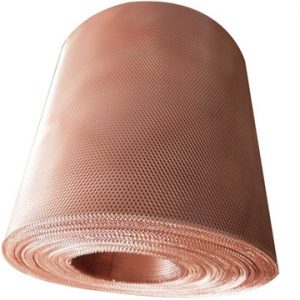
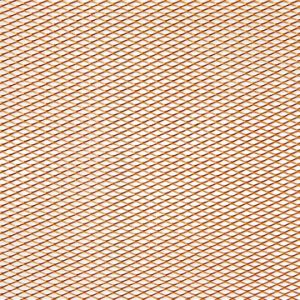
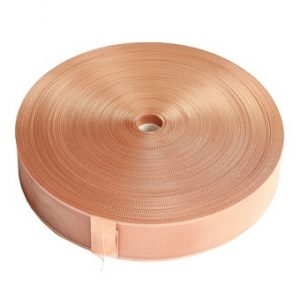
Battery copper mesh, also known as electrode copper mesh, is typically a diamond-patterned mesh formed by expanding a copper sheet.
Battery manufacturers generally focus on the mesh’s areal density.
Areal density influences both electrical conductivity and cost.
Battery copper mesh is commonly used as a current collector substrate for the cathodes of Ni-MH batteries and the anodes of lithium-ion batteries. Its core function is to collect the current generated by the active electrode material and conduct it efficiently to the external circuit, while simultaneously providing mechanical support for the active material coating.
Functions:
Current Collection and Conduction: Acts as a current path for the anode, efficiently conducting electrons generated by the active material during charge and discharge cycles to the battery tab and external circuit with minimal loss.
Mechanical Support: Supports the anode active material coating, providing structural strength and stability to prevent the coating from detaching or deforming during battery manufacturing and use.
Conductive Framework: Provides a three-dimensional conductive network for the active material, facilitating rapid electron transport within the electrode and reducing internal resistance.
Key Characteristics:
Facilitates Electrolyte Wetting: The mesh openings allow the electrolyte to penetrate more fully into the electrode, contacting more active material, improving ion transport, and enhancing reaction uniformity.
Lightweight: Compared to solid foil of the same area, copper mesh is lighter, helping to increase the battery’s energy density.
Provides Anchoring Points for Active Material: The mesh structure increases the contact area and mechanical interlocking between the coating and the current collector, enhancing coating adhesion.
Accommodates Volume Changes: For active materials that undergo significant volume changes during charge and discharge, the mesh structure provides buffer space, alleviates stress concentration, and improves cycle stability.
Excellent Conductivity: Copper has the highest electrical conductivity of any metal except silver; it significantly reduces the current collector’s ohmic resistance, thereby improving the battery’s energy efficiency and rate capability.
Good Chemical Stability: Copper is relatively stable and does not readily react violently with the electrolyte.
Appropriate Mechanical Strength: Requires sufficient strength to support the coating and withstand mechanical stress during battery manufacturing, while maintaining enough flexibility to accommodate winding or stacking processes.
Porous structure: This is the key feature that distinguishes copper mesh from solid copper foil.